
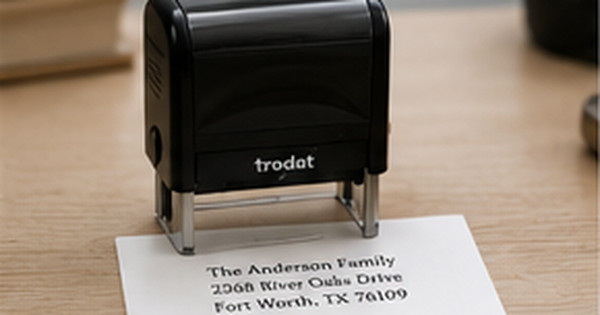
What Size Address Stamp Do You Need? A Practical Measuring Guide
Posted by Affordable Address Labels on Apr 8th 2021
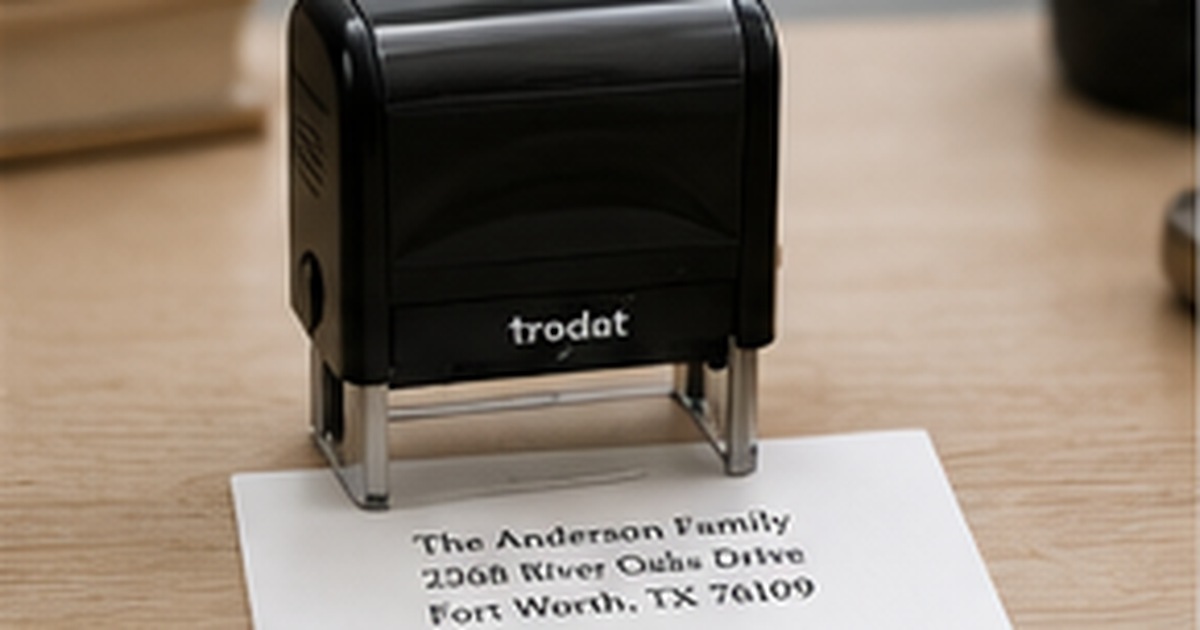
Address stamps are sold in compact, standard, and oversized formats, but product names do not tell you how the impression will feel on your envelopes. A stamp that is too small forces thin type and crowded lines. A stamp that is too large can overwhelm note cards and become difficult to position.
Choosing the right size starts with the surface you use most often. Measure the available space, count the information that must fit, and judge a proof at actual size rather than relying on an enlarged design preview.
Measure the smallest common envelope first
Gather the envelopes, cards, packages, or forms the stamp will touch most frequently. Measure the usable return-address area on the smallest item, allowing room for the envelope edge, flap seam, postage, recipient address, and any decorative border.
A compact stamp may be ideal for personal notes and small envelopes. A wider model can improve readability for four-line business addresses, long company names, or a logo. The correct size is the largest impression that remains comfortable on the smallest regular surface.
Count lines and identify the longest text
Most household stamps use three lines: name, street, and city/state/ZIP. Apartments, company departments, long street names, or country information may require a fourth line. Every added line reduces available type size unless the stamp becomes taller.
Use the longest likely version of each line in the proof. A sample built from short placeholder text can look spacious while the real address becomes compressed. Check capital letters, punctuation, suite numbers, and ZIP+4 if those details will appear.
Match the design style to the available dimensions
Simple sans-serif and serif layouts can remain legible at smaller sizes. Script names, circular borders, monograms, and logos need more breathing room. If decoration is important, increase the impression size or simplify another element rather than shrinking the address.
Round stamps require special attention because the usable horizontal width narrows near the top and bottom of the circle. A circular design that fits on screen may still feel crowded when produced at a compact diameter.
Print an actual-size paper test
Ask for the impression dimensions, then create a rectangle or circle with those measurements in a document. Place the proof inside it and print at 100 percent. Cut out the sample and position it on the intended envelopes.
This test reveals scale immediately. View it from arm’s length, check whether the ZIP code is obvious, and confirm that the stamp can be aligned without touching an edge. Repeat with the next size if the first version feels cramped or oversized.
Make a paper sizing kit before ordering
Print the proposed impression in two or three candidate sizes and cut each version to its exact dimensions. Keep the samples with the envelopes, tags, or forms that will receive the stamp. Comparing physical pieces makes differences in scale much easier to judge than switching between enlarged online previews.
Ask another person to read each sample quickly and identify which version feels easiest to place. The largest design is not automatically best; it may crowd small envelopes or require unusually careful alignment. Choose the size that leaves a comfortable margin, supports the longest address, and can be positioned accurately during repetitive use.
Quick checklist
- Measure the smallest regular surface
- Count every required address line
- Use the longest real text in the proof
- Allow extra room for scripts and logos
- Print a 100-percent-size mockup
- Confirm refill and replacement-pad availability
Frequently asked questions
What is a common personal address stamp size?
Many personal layouts fit in a compact rectangle around one to two inches wide, but exact needs depend on line length, font, and decoration.
Should a business address stamp be larger?
Often yes, especially when it includes a company name, department, phone number, or logo. Size should be driven by readability rather than business use alone.
Can I use one stamp on envelopes and boxes?
Only when both surfaces accept the ink and offer a flat area of suitable size. Adhesive labels may be more reliable on glossy, textured, or uneven packaging.
Choose the smallest size that stays comfortably readable
A well-sized stamp feels natural on the surface and preserves enough space for every line. Measure first, print an actual-size test, and simplify artwork before sacrificing legibility. Compare personalized rubber stamps and keep address labels available for surfaces that do not stamp cleanly.