
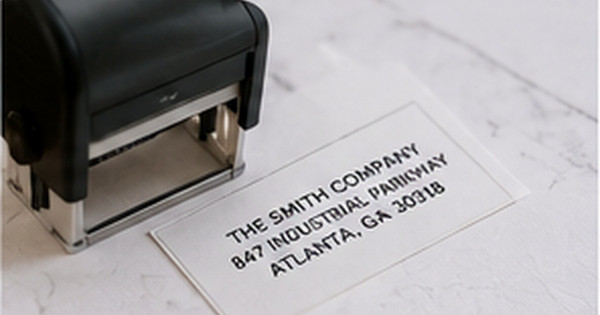
Using Address Stamps for Your Business: Setup, Design, and Workflow
Posted by Affordable Address Labels on Jun 3rd 2023
A business address stamp is a modest tool with an outsized effect on repetitive office tasks. It can mark outgoing envelopes, return forms, paper bags, information cards, internal documents, and approved packaging surfaces in a few seconds.
The stamp should be treated as part of the operating system, not only as a decorative purchase. The right size, exact business name, controlled access, refill plan, and update procedure determine whether it saves time or creates confusion.
List the exact jobs before designing the stamp
A return-address stamp may need only the business name and mailing address. A deposit stamp, received-date stamp, inspection mark, or packaging stamp has a different purpose and should not be combined into one crowded design. Separate stamps are usually clearer and easier to control.
Measure the available space on the smallest envelope, card, or bag. Leave room for shipping labels, barcodes, postage, and handwritten information. Choosing the imprint size first prevents artwork from being reduced until it becomes unreadable.
Use the official business identity consistently
Decide whether the stamp should use the legal name, DBA, storefront name, department, or return center. Compare it with invoices, the website, bank records, and customer correspondence. A familiar customer-facing name can be useful, but the address must route mail reliably.
If the company has multiple locations, add a short branch or department identifier. Store and label each physical stamp so staff members cannot easily use the wrong return address.
Simplify the artwork for a clean impression
Small logos often need adjustment before they become stamp-ready. Remove gradients, fine shading, hairline rules, and tiny reversed text. A bold one-color mark, clear business name, and readable address usually make a stronger impression than a miniature version of the full brand lockup.
Test long company names and suite lines at actual size. If space is limited, abbreviate common address elements consistently rather than squeezing the type. The stamp should remain readable after hundreds of routine impressions, not only in the perfect sample.
Create a refill, storage, and update process
Assign a storage location near the work it supports and keep the approved refill product with the stamp record. Train users to press evenly, allow ink to dry, and avoid stamping across folds or textured seams.
When an address or business name changes, remove the old stamp from circulation immediately. Destroy or clearly archive it; do not leave it in a shared drawer. Record the order date, imprint proof, model, and refill information for every active stamp.
Document the approved version and owner
Save the final artwork, exact wording, order date, vendor details, and reorder number in a shared business record. Assign one person or role to approve address changes and remove obsolete supplies so different versions do not circulate at the same time.
Review the item inside the real workflow after several weeks. Ask the people packing orders or preparing mail whether the size, placement, and storage location save time. Operational feedback is more valuable than judging the design only from a desk proof.
Decide when not to use the stamp
Not every surface or document should receive the same imprint. Carrier labels, legal forms, checks, glossy packaging, and customer-owned materials may require printed information, a different approved stamp, or no added mark at all. Document the allowed uses so speed does not create an avoidable compliance or presentation problem.
If a stamped impression varies too much between users, add a simple positioning guide or switch that task to a printed label. Standardization is the purpose of the tool. A process that depends on one employee knowing exactly how hard to press is not yet a reliable business workflow.
Quick checklist
- Define one job per stamp
- Measure the smallest surface
- Confirm the exact business name and address
- Simplify logos for one-color reproduction
- Test on the final material
- Document refill and replacement information
Frequently asked questions
Should the stamp include a phone number?
Only if it supports the task and remains readable. Many envelopes and forms need only the business name and mailing address.
Can a business stamp be used on boxes?
Yes on suitable smooth areas, but test the ink on the specific cardboard or coated surface and keep clear of carrier labels and seams.
Who should be allowed to use operational stamps?
Access should match the risk. General return-address stamps may be widely shared; financial, approval, or official-status stamps should be controlled.
Standardize the small tasks that repeat every day
A well-planned business stamp reduces handwriting, reinforces identity, and helps staff complete routine work consistently. Explore custom business stamps and coordinate them with return address labels and customer thank-you cards where adhesive or printed pieces are the better fit.