
How to Build a Coordinated Mail Kit for Everyday Correspondence
Posted by Affordable Address Labels on Nov 16th 2025
A coordinated mail kit removes the friction that keeps thoughtful notes from being sent. When cards, envelopes, address labels, postage, and a reliable pen live in one place, writing a thank-you note or birthday card becomes a five-minute task instead of a search through several drawers.
Coordination does not mean every item must match perfectly. The goal is a small collection that feels intentional, works for multiple occasions, and reflects your taste. A restrained color palette and a few repeatable design details can make even an inexpensive stationery drawer feel organized.
Start with the correspondence you actually send
Review the last six months. Did you send thank-you notes, birthday cards, condolence cards, school notes, client messages, or holiday greetings? Build around those real habits rather than an imagined formal stationery set. Blank cards and simple folded notes often cover more occasions than highly specific designs.
Choose two or three card styles at most: a neutral everyday card, a warmer celebratory option, and a restrained sympathy or support card. This keeps the kit useful without turning it into another storage problem.
Use one visual thread
A shared color, monogram, botanical motif, border style, or type family can tie the pieces together. Your return address labels might use the same navy and cream palette as your note cards even if the artwork differs. That small connection is enough to create a finished look.
Avoid forcing decorative fonts onto every surface. A script may look beautiful on a card front but become difficult to read on a small return label. Repeat the mood and color rather than copying every element literally.
Include the practical tools
A useful kit needs more than paper. Add a dark, quick-drying pen; standard postage stamps; a small ruler; correction labels; and a list of frequently used addresses. If you often send packages, include a self-inking return stamp and a roll of plain sealing stickers.
Check the pen on your envelopes before relying on it. Coated, dark, or textured envelopes may need a different ink than ordinary paper. A test envelope prevents smearing and saves a finished card from being rewritten.
Store the kit where writing happens
The ideal location is not necessarily an office. A dining-room sideboard, kitchen command center, or bedroom desk may be more convenient. Use a shallow box, divided drawer, or portable caddy so the entire set can move to a comfortable writing surface.
Restock postage and address labels when supplies reach about one quarter of the original amount. That threshold leaves enough time to reorder before a holiday or event creates a sudden need.
Core pieces for an everyday mail kit
- Neutral folded note cards
- Two envelope sizes
- Personalized return address labels
- A self-inking address stamp
- Black or blue quick-drying pens
- Postage stamps
- Address list
- Small storage box or caddy
Review the design in the context where it will be used
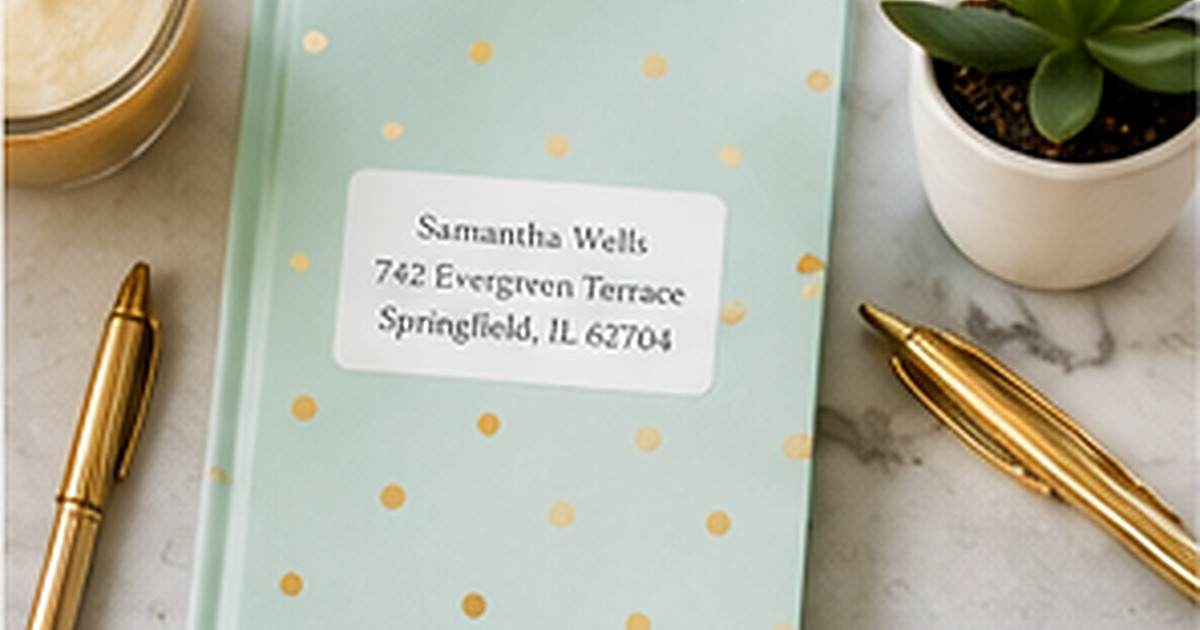
Place a printed sample of the coordinated mail kit on the actual envelope, card, container, or package. Scale, color, and spacing can feel very different on a real object than they do in an enlarged online preview. The surrounding materials should support the design rather than compete with it.
Read every personalized line aloud and compare the address against a trusted source. Check names, abbreviations, apartment numbers, ZIP codes, and punctuation. When two people share the proofing task, one can read the original information while the other checks the final design line by line.
Finally, decide how the item will be stored and reordered. Save the design name, product number, quantity, and order date. That information turns a successful first purchase into a dependable part of the household stationery routine.
Common mistakes to avoid
- Choosing style before confirming the wording
- Reducing type until a long line barely fits
- Using too many fonts or decorative elements
- Ignoring the color of the final envelope or surface
- Ordering a large quantity before testing one sample
A careful proof and a small real-world test prevent most of these problems. Make the design attractive, but let accuracy, readability, and ease of use guide the final decision.
Frequently asked questions
Does all stationery need to match?
No. A coordinated set only needs one or two connecting details, such as color, type style, or a simple motif.
How many cards should I keep on hand?
Start with ten to twenty versatile cards. Add occasion-specific cards only when you regularly use them.
Should postage be stored with the kit?
Yes. Keeping postage with cards and labels prevents a completed note from sitting unsent on a counter.
What is the best pen for envelopes?
A quick-drying rollerball, gel pen, or fine permanent marker can work well, but test it on the actual envelope surface first.
Build a stationery system that fits real life
The best personalized paper goods are the ones you reach for often. Choose clear, accurate designs, store them where correspondence happens, and reorder before a holiday or event creates a rush. Explore personalized address labels, rubber stamps, and greeting cards to create a practical set for home, celebrations, or business mail.