
How Many Address Labels Do You Need for a Major Life Event?
Posted by Affordable Address Labels on Feb 21st 2018
Major life events create more mail than most people expect. A move may involve announcements and account updates, while a wedding can include save-the-dates, invitations, thank-you notes, and vendor correspondence. Ordering too few labels creates a frustrating second order; ordering far too many leaves outdated names or addresses in a drawer.
A useful estimate begins with the actual mailing stages, not a generic package size. Count likely recipients, add household and administrative uses, then build in a modest margin for mistakes and late additions.
Count mailings, not just people
Start by listing every mailing tied to the event. A wedding guest may receive a save-the-date, invitation, and thank-you note, which means the same household can require three return labels. A move may include change-of-address cards, thank-you notes, school forms, and ordinary correspondence from the new home. Multiplying the recipient count by the number of planned mailings gives a more realistic baseline than counting names once.
Separate guest mail from administrative use
Life events also create paperwork. New-home labels may go on utility forms, school envelopes, warranty cards, and household files. Couples may use labels for vendor deposits, wedding-party gifts, and post-event returns. Add a small administrative allowance rather than assuming every label will be used on a social card.
Build a margin without ordering for the next decade
A margin of roughly ten to twenty percent is usually enough for address corrections, damaged envelopes, late additions, and testing. The goal is flexibility, not a lifetime supply. If a name, address, or household structure may change soon, keep the first order conservative and save the approved design for easy reordering.
Choose a design that survives the full event cycle
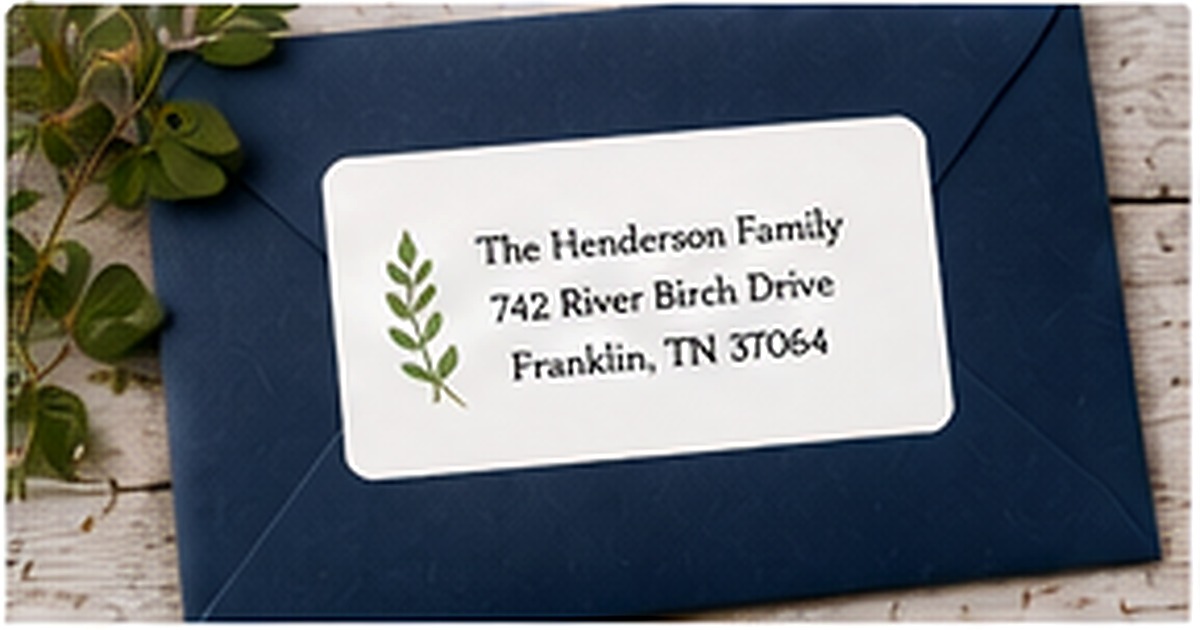
Event-specific artwork can be charming, but a versatile label often provides more value. A wedding design with subtle florals may work on thank-you notes long after the ceremony, while a new-home label should still feel appropriate on holiday cards. The more stages a design can cover, the easier it is to use the quantity efficiently.
Track use before reordering
Keep a small note with the original quantity and the number remaining after each mailing. This creates a real usage history for the next event and helps identify whether the label size, wording, or design should change. Reorder from evidence instead of guessing again.
Common label mistakes to avoid
The most common problems with how many address labels do I need come from choosing appearance before function. Text is reduced until it is difficult to read, decorative elements compete with the address, or a label is ordered without testing the longest name and darkest envelope. Another mistake is ordering a large quantity before the wording and location are stable. Use an actual-size proof and judge the label in the setting where it will be used, not only as an enlarged image on a screen.
Test the design on real materials
Apply a sample to the smallest envelope, darkest paper, or most textured surface in the planned set. Complete the piece with recipient addressing and postage so spacing can be evaluated honestly. Ask another person to read the name and address without help. List every planned mailing stage should be obvious at normal viewing distance. Testing one finished piece is inexpensive compared with discovering the problem after every envelope has been assembled.
Review quantity, storage, and future use
Labels remain useful only when the information stays accurate and the sheets are stored well. Keep them flat, dry, and grouped with the related stationery. Review the remaining quantity before each major mailing and remove outdated versions. Multiply recipients by the number of mailings provides a practical standard for deciding whether to reorder, revise the design, or use a smaller temporary supply. A well-managed label system saves more time than an oversized collection of nearly correct options.
Document the version that works
Once the how many address labels do I need setup has been tested, save the exact wording, dimensions, image choice, order date, and quantity in a simple household or business file. Include a photograph of the finished piece and note any changes you would make next time. This record shortens future proofing, prevents old addresses or names from returning, and makes reordering easier for another family member or employee. Good documentation turns a one-time stationery decision into a dependable repeatable process.
Quick checklist
- List every planned mailing stage
- Multiply recipients by the number of mailings
- Add administrative uses and a modest error margin
- Order conservatively when names or addresses may change
Frequently asked questions
Is one label needed per invitation?
Usually one return label is needed per outer envelope, not per individual guest. Households receiving one invitation count as one mailing piece.
How many extras should I order?
A ten-to-twenty-percent margin covers most mistakes and late additions without creating excessive leftovers.
Can one design work for several stages?
Yes. A restrained design can often serve announcements, invitations, thank-you notes, and ordinary correspondence.
Put the system into practice
A clear plan makes stationery easier to use and easier to reorder. Review the wording at actual size, choose a realistic quantity, and explore personalized address labels and greeting cards that fit the way the household or business actually communicates.