
Eco-Friendly Address Labels: Sustainable Choices for Everyday Mail
Posted by Affordable Address Labels on Apr 22nd 2019
Address labels are small, but a household or business may use hundreds over time. Shoppers who want a lower-impact stationery routine can make better choices by looking beyond a single green claim and considering the whole life of the product: material, print coverage, adhesive, packaging, quantity, and whether the labels will actually be used.
Sustainability is rarely an all-or-nothing decision. A practical order that avoids waste can be more responsible than a large supply of specialty labels that becomes outdated. The goal is to choose materials and quantities thoughtfully while preserving the readability and reliability needed for real mail.
Start with the face material
Paper labels are often the easiest fit for ordinary envelopes because paper can move through established recycling streams when it is attached to paper mail. Recycled-content stock may reduce the demand for virgin fiber, while uncoated or lightly coated finishes can offer a natural appearance with less visual emphasis on plastic-like gloss.
Material descriptions should be read carefully. Terms such as natural, kraft, recycled, compostable, and recyclable are not interchangeable. The final disposal route depends on the label, adhesive, backing liner, local facilities, and what the label is attached to. When environmental attributes matter to a purchase, ask the seller for specific material information rather than relying on color or texture alone.
Use design to reduce unnecessary coverage
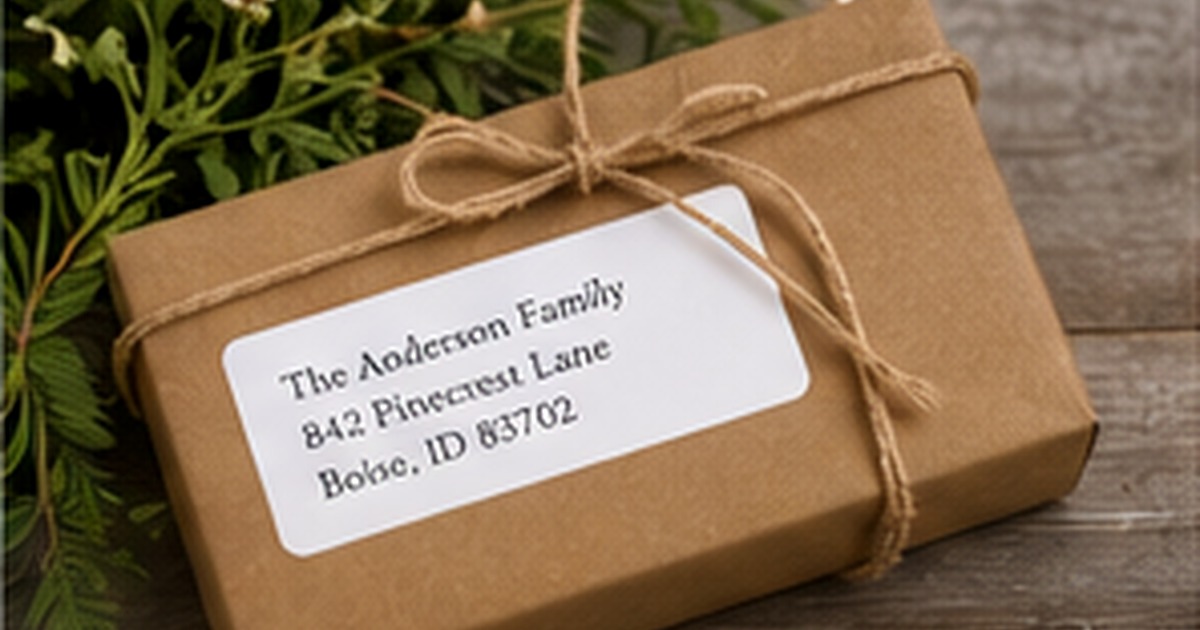
A beautiful label does not need a full field of heavy ink. White space, a small botanical motif, one- or two-color typography, and a restrained border can create a distinctive design while keeping the address easy to read. Simpler artwork also tends to coordinate with more envelope colors and seasons, which helps the supply stay useful longer.
Avoid reducing type merely to fit more decoration. An eco-minded label that causes addressing mistakes or must be replaced is not serving its purpose. Clear hierarchy—name first, street second, city/state/ZIP third—supports both usability and a clean visual style.
Order a quantity you can realistically finish
Over-ordering is one of the easiest ways to create waste. Estimate holiday cards, monthly correspondence, customer shipments, and event mailings for the next year or two. Add a reasonable buffer, but consider whether a move, rebrand, new family name, or business address could make the labels obsolete.
Smaller, well-timed reorders can also keep the design aligned with current needs. Save the product number and final proof so a successful label can be reordered without rebuilding the artwork from scratch.
Consider the full mailing system
Labels are only one part of the package. Reusable storage, right-sized envelopes, minimal inserts, and a coordinated card that serves a real purpose can reduce clutter. For business shipments, one useful thank-you or care card is often better than several generic pieces that customers discard immediately.
Store sheets flat and dry so the adhesive remains usable. Use older stock first, and keep a small quantity at the writing desk instead of opening multiple packs. Good storage extends product life and prevents damaged corners, curling, and forgotten duplicates.
Evaluate the finished label in real use
Before committing to a large reorder, place the label on several envelopes and view it at normal reading distance. Check the longest address, the darkest envelope, and the occasion where the design will be used most often. A full-size test catches spacing and contrast problems that an enlarged preview can hide.
Store the approved design name, quantity, and order date with a photo of the finished envelope. That record makes later reorders faster and helps the household decide whether the same design still fits after a move, name change, new season, or shift in mailing habits.
Quick checklist
- Ask what the face stock is made from
- Choose a versatile low-coverage design
- Order for a realistic time horizon
- Avoid claims that are not backed by material details
- Store labels to protect the adhesive
- Use the entire stationery system efficiently
Frequently asked questions
Are kraft labels automatically recycled?
Not necessarily. Kraft describes an appearance or paper type, but recycled content should be confirmed separately.
Can a label on an envelope be recycled?
Paper labels on paper envelopes are commonly processed with the envelope, but local recycling rules and adhesive formulations vary.
Is the backing liner recyclable?
Many release liners are not accepted in curbside bins. Check local programs or specialty collection options before assuming they belong with mixed paper.
Make the most responsible choice available to you
A sustainable stationery routine combines informed materials, useful design, careful quantities, and complete use of what you buy. Explore personalized address labels with a simple, versatile layout and pair them with greeting cards selected for occasions you genuinely plan to send.