
Couples’ Return Address Labels: Naming Formats for Shared and Different Last Names
Posted by Affordable Address Labels on Nov 2nd 2018
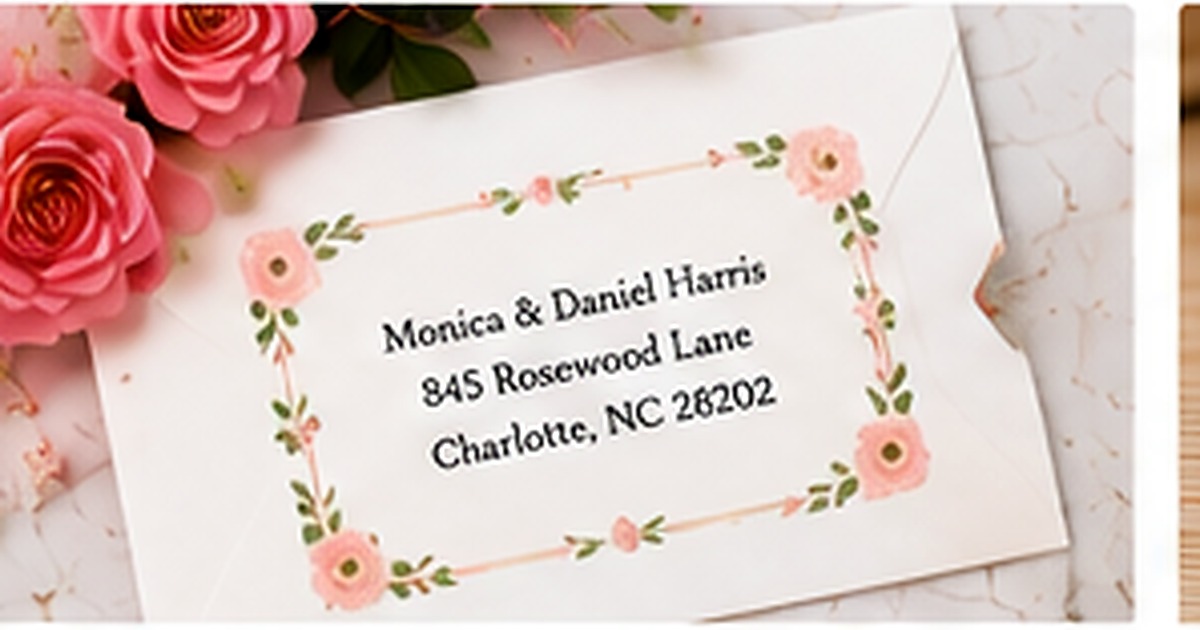
A return-address label should reflect the people who actually live in the household. Traditional formats are useful options, but they are not rules that require couples to change or hide their names.
The best format is accurate, readable, and comfortable for both partners. It should also fit the label shape without shrinking the type or forcing awkward abbreviations.
Shared surname formats
Couples who share a surname may use two full names, first names with a shared surname, or a household line such as “The Harris Family.” Two full names are the clearest choice for formal correspondence, while a family line is compact and flexible for everyday mail.
Different surnames on one label
When partners use different surnames, list both full names in the order they prefer. A centered two-line format often reads better than squeezing both onto one line. Avoid assumptions about whose name should appear first; consistency and mutual preference matter more than tradition.
Hyphenated names and long professional titles
Long names require careful proofing. Consider removing optional titles, stacking names on separate lines, or choosing a wider rectangular label. If professional titles are important for formal mail, test the complete wording at actual size before ordering.
Family, household, and name-free alternatives
A neutral household line can work for blended families, roommates, or couples who want a flexible format. Another option is an address-only label paired with a monogram or small motif. These approaches remain useful when household names or circumstances may change.
Keep the format consistent across the stationery suite
Save-the-dates, invitations, thank-you notes, and holiday cards look more polished when the return name is presented consistently. Decide the format once, proof it carefully, and reuse the approved wording across labels and stamps.
Common label mistakes to avoid
The most common problems with couples return address label format come from choosing appearance before function. Text is reduced until it is difficult to read, decorative elements compete with the address, or a label is ordered without testing the longest name and darkest envelope. Another mistake is ordering a large quantity before the wording and location are stable. Use an actual-size proof and judge the label in the setting where it will be used, not only as an enlarged image on a screen.
Test the design on real materials
Apply a sample to the smallest envelope, darkest paper, or most textured surface in the planned set. Complete the piece with recipient addressing and postage so spacing can be evaluated honestly. Ask another person to read the name and address without help. Use the names each partner actually uses should be obvious at normal viewing distance. Testing one finished piece is inexpensive compared with discovering the problem after every envelope has been assembled.
Review quantity, storage, and future use
Labels remain useful only when the information stays accurate and the sheets are stored well. Keep them flat, dry, and grouped with the related stationery. Review the remaining quantity before each major mailing and remove outdated versions. Stack long names rather than shrinking them excessively provides a practical standard for deciding whether to reorder, revise the design, or use a smaller temporary supply. A well-managed label system saves more time than an oversized collection of nearly correct options.
Document the version that works
Once the couples return address label format setup has been tested, save the exact wording, dimensions, image choice, order date, and quantity in a simple household or business file. Include a photograph of the finished piece and note any changes you would make next time. This record shortens future proofing, prevents old addresses or names from returning, and makes reordering easier for another family member or employee. Good documentation turns a one-time stationery decision into a dependable repeatable process.
Quick checklist
- Use the names each partner actually uses
- Stack long names rather than shrinking them excessively
- Choose a wider label for titles or hyphenated surnames
- Keep the naming format consistent across mailings
Frequently asked questions
Whose name should come first?
There is no universal requirement. Use the order the couple prefers and keep it consistent.
Can we use “The Smith-Jones Family”?
Yes, if that description feels accurate to the household and fits comfortably on the label.
Is an address-only label acceptable?
Absolutely. An address-only design is flexible and can be paired with a monogram or neutral motif.
Put the system into practice
A clear plan makes stationery easier to use and easier to reorder. Review the wording at actual size, choose a realistic quantity, and explore personalized address labels and greeting cards that fit the way the household or business actually communicates.